
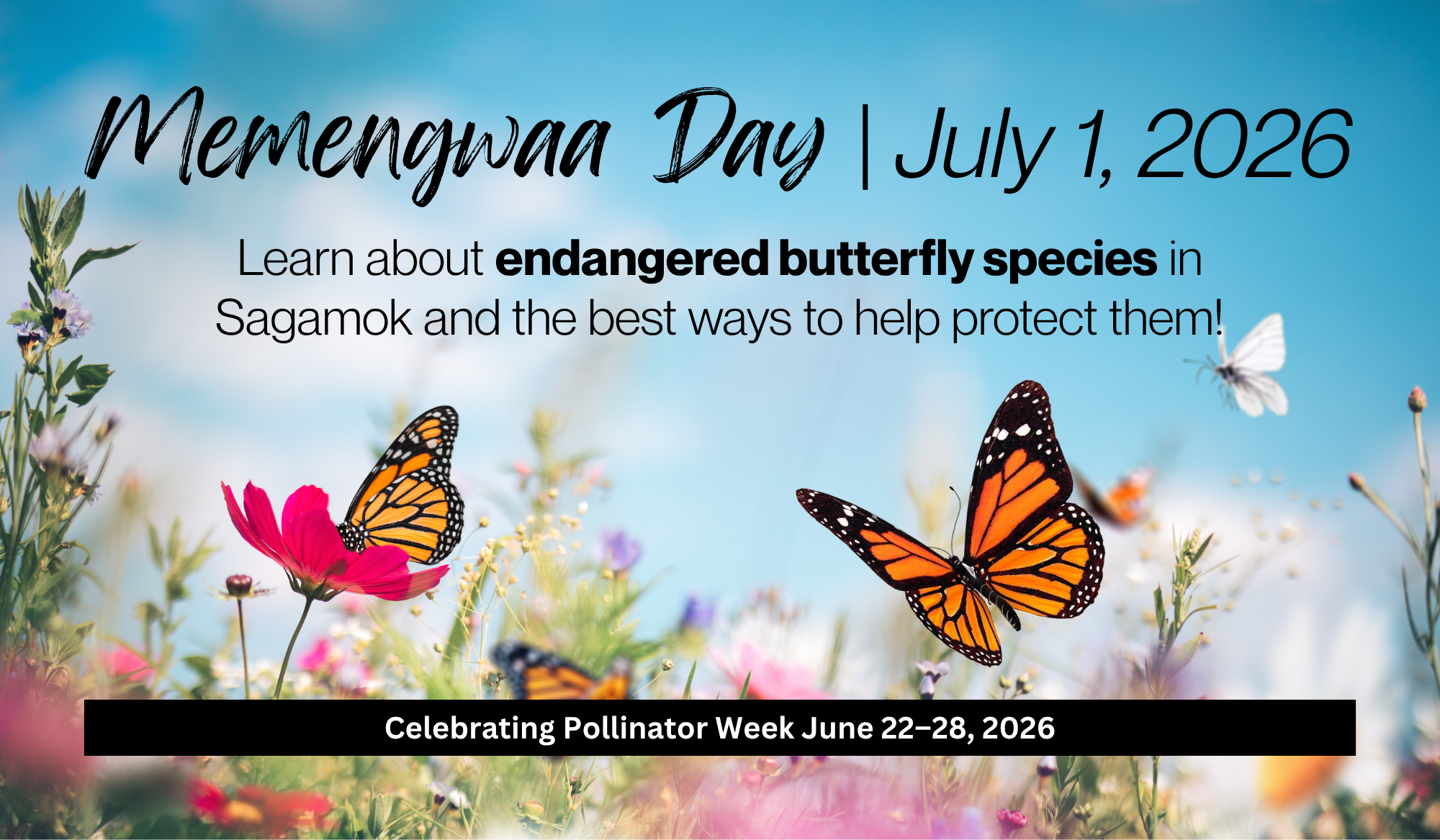
Memengwaa Conservation
Ontario has several memengwaa (butterfly) species at risk, with the Monarch listed as Endangered federally and the Mottled Duskywing listed as Endangered in Canada. The primary drivers of decline include agriculture, pesticide use, and the destruction of habitats like oak savannas and tallgrass prairies. Several of Ontario's most iconic memengwaa (butterflies) are currently facing severe population declines due to habitat loss, climate change, and pesticide use.
Key Memengwaa (Butterflies) at Risk in Sagamok
- Monarch (Danaus plexippus): Endangered federally, listed as Special Concern provincially in Ontario. Their decline is driven by the loss of milkweed (their caterpillars' sole food source) and habitat destruction at overwintering sites in Mexico.
How to Help
- Plant a Butterfly Garden: Choose native nectar plants and milkweed to provide food and shelter for memengwaa (butterflies).
- Track Migrations: Report your sightings or explore tagging programs through Monarch Watch.
- Learn and Explore: Discover which butterfly and pollinator species are native to Ontario using resources from the Canadian Wildlife Federation.
- Get Familiar: Use Pollinator Partnership Canada's Ecoregional Guides to find exactly what thrives in your immediate area.
Don't cut milkweed. To protect local monarch populations around Sagamok, leave native milkweed standing through spring and summer. Cutting milkweed removes vital host plants for caterpillars and disrupts breeding, since it is the exclusive host plant for monarch caterpillars.
Plant native pollinator gardens. Butterflies require both host plants (where they lay eggs and caterpillars feed) and nectar plants (where adults feed). Some ozaagakiig (plants) that help pollinators include:
- Ininiwizh (Common Milkweed)
- Bu'giso'win (Swamp Milkweed)
- Giizisobagoons (Coneflowers)
- Namegosibag (Astors)
- Giizisomashkiki (Goldenrod)
- Zaasab (Wild Bergamot)
- Ode'imin (Wild Strawberry)
- Gozigwaakomin (Serviceberry)
- Wezawab-gonik (Blazing Star)
- Bu'gisowe (Joe-Pye Weed)
No chemicals. Pesticides and herbicides (especially neonicotinoids) are devastating to memengwaa (butterfly) populations. Eliminating the use of these chemicals ensures a safer environment for caterpillars and adult memengwaa (butterflies).
Provide "puddling" stations. Memengwaa (butterflies) drink water and extract necessary minerals from damp mud. You can make a simple puddling station by filling a shallow dish with sand and gravel and keeping it moist with fresh water.
Become a community scientist. Conservation groups and government agencies rely on public sightings to map populations and track the recovery of at-risk species.
- Record and submit your butterfly observations to iNaturalist Canada.
- If you encounter endangered species, consider reporting them directly to Ontario's Natural Heritage Information Centre.
Memengwaa-Related Words
- Memengwaa: "Butterfly"
- Memengwaans: The diminutive form - "little butterfly"
- Wemigwans: A phonetic variation, often used in specific regions and storytelling
- Biijimaanijigan: Insect antenna - translates to "something used to smell with"
- Moose: "Caterpillar"
- Gashkiiwegii'idizo: "S/he wraps h/self up"
- Giichigotaa: "S/he pulls or breaks out of the cocoon"
- Memengwaawid: "To become a butterfly"
- Manidoons oningwiigan: Insect singular wing
- Manidoonsag oningwiiganan: Insect plural wings
- Gashkiiwegii'idizo moose: "The caterpillar wraps himself up"
- Waabigwan: "A flower" (singular)
- Waabigwaniin: "Flowers" (plural)
- Waabigwaniikaa: "There are many flowers" (often used to describe a garden or meadow in full bloom)
- Waabigwanii-gitigaan: "A flower garden"
- Gitigaan (ni): A garden, field, or farm
- Aniibiish: "Leaf" (singular)
- Aniibiishan: "Leaves" (plural)
- Manidoons: "Insect" (singular)
- Manidoonsag: "Insects" (plural)
Resources
- Free Milkweed seeds: https://littlewings.ca/get-milkweed-seeds/
- School Conservation Programs & Learning
- Wild Spaces for Monarchs: The Canadian Wildlife Federation (CWF) offers a curriculum-linked education program for classrooms. Students learn about monarch habitats and lifecycles, and then actively plan and plant a monarch garden at their school.
- Little Wings School Programs: Classes across Canada can register to receive milkweed seed packets to distribute or plant and will be listed on the national Little Wings pollinator map. https://littlewings.ca/get-milkweed-seeds/
- Community Science & Teacher Training
- Mission Monarch: Spearheaded by the Montréal Space for Life Insectarium, this community science program invites students and educators to record and document monarch caterpillars and milkweed. The data helps identify breeding hotspots and supports international conservation measures. https://www.mission-monarch.org/
- Monarch Teacher Network of Canada: Administered bythe TRCA, this program offers immersive "Teaching & Learning with Monarch Butterflies" workshops. Educators learn how to raise monarchs ethically and legally in the classroom (including Ministry permitting) while integrating environmental stewardship into their curriculum. https://trca.ca/learning/professional-development/monarch-teacher-network-canada/
- The Ontario Butterfly Species at Risk portal
- Ontario Butterfly Species at Risk Recovery Team
- Memengwaa: The Monarch Butterfly Colouring & Workbook: This is an educational and cultural activity book by Dorothy Ladd for youth. Written in both English and Ojibway, it teaches children about the life cycle of the monarch butterfly and incorporates traditional Indigenous storytelling.
For more information, feel free to reach out to Chevaun Toulouse at 705-863-1069.


