Sagamok Anishnawbek Koognaasewin Initiative
With Mamaweswen, The NorthShore Tribal Council’s (NSTC) Koognaasewin project ending on June 30, 2026, individual North Shore First Nations have moved forward to independently map out their respective Koognaasewin Law and System Design. For Sagamok, our Koognaasewin initiative has continued to ramp up over the last year, with a Draft Koognaasewin Law currently in review as well as Child and Family program expansion, policies, procedures, and work plan development, and negotiations (with Canada and Ontario) all underway.
In upcoming blog posts, we’ll be delving deeper in the details of Sagamok’s Koognaasewin System Design, Service Delivery Model, and Work Plan. We’ll also explore the Draft Koognaasewin Law so everyone can better understand how the Koognaasewin Law and accompanying System Design will shape future Child Wellbeing programming. While no date has been set, ratification of Sagamok’s Koognaasewin Law will likely occur in mid-2027.
Koognaasewin – ChildWellbeing, began under the NSTC in 1987 through a resolution to re-establishcommunity care for children and families. Other key milestones include:
- 2009: The NSTC authorized Nogdawindamin to pursue designation as a full-service child welfare agency under Ontario’s Child and Family Services Act as an interim measure until full jurisdiction under Anishinaabe Child Welfare Law could be exercised.
- 2017: Nogdawindamin became a fully mandated child welfare agency operating under Ontario law.
- 2018: The NSTC passed a resolution to proceed with the next phase of development, focusing on community engagement, consultation, and planning to ensure informed decision-making.
- 2019: The Federal Government enacted Bill C-92 (formerly called An Act respecting First Nations, Inuit and Métis children, youth and families) affirmed Indigenous jurisdiction over child welfare with the primary aim of reducing the over-representation of Indigenous children in care and prioritizes cultural continuity.
- 2024: The Supreme Court of Canada ruled thatBill C-92 is constitutional.
Key Aspects of Bill C-92 include:
1) Jurisdiction: Recognizes the inherent right of Indigenous communities to create their own child and family service laws, which can take precedence over provincial/federal laws.
2) National Standards: Establishes minimum standards, including the "best interests of the child," cultural continuity, and substantive equality.
3) Preventative Focus: Shifts focus from apprehension to prevention, keeping children with their families and communities.
4) Constitutional Validation: In February 2024, the Supreme Court of Canada unanimously upheld the constitutionality of the Act, confirming it falls within federal jurisdiction.
5) Implementation : Indigenous groups can now exercise jurisdiction through two options: (1) creating their own laws; or (2) coordinating with existing provincial/federal systems.
Now that the regional project has come to an end, the work now sits with each First Nation independently. As an introduction to Sagamok’s Koognaasewin initiative, let’s start with a brief overview of important highlights over the last five years of the NSTC’s Koognaasewin initiative:
- October 2018: NSTC passed a resolution to proceed with a new phase of Child Wellbeing that focused on community engagement, consultation, and planning to ensure informed decision-making regarding Law development.
- October 29-30, 2019: Leadership and seniormanagers from NSTC, Nogdawindamin, and the Elders Council convened to discussthe development of the child well-being law. Key discussions emphasized theimportance of grounding the law in Anishinaabe teacings, spirituality, andtraditional practices.
- 2021: Koognaasewin Initiative begins in earnest with the core team hired to begin the comprehensive capacity development process, including a broad-based introduction of the Koognaasewin initiative to North Shore communities, and begin the process of supporting community-led Child Wellbeing Law development processes and visioning.
- 2021-2022: Anishinaabe Customs and Traditions Research on Child Wellbeing is completed, capturing stories and teachings from North Shore First Nations’ Elders, Knowledge Keepers, and Grannies and Aunties groups on raising children, as well as gathering historical information sourced from local and regional archived material on Anishinaabe practices in childrearing.
- 2023: Koognaasewin began focusing on data governance and sovereignty to support the development of a Child Wellbeing Law. A contractor was hired to conduct ethnographic research to gather stories from North Shore First Nations’ members with Lived Experience with the child welfare system. Separate ethnographic research was conducted to gather input from child welfare staff along the North Shore on their experiences in the local child welfare system.
- June 2024: Phase 2 of the Koognaasewin Data Governance Project was initiated, focusing on data assessment, community engagement, and the development of a conceptual framework for measuring child and family well-being.
- March 31, 2025: The Koognaasewin Team, together with a Legislative Drafter, released the Draft Generic Koognaasewin Child Wellbeing Law and accompanying System Design & Service Delivery Model. With this generic version in hand, a robust generic Law was made available to North Shore First Nations for individual community’ adoption/adaptation for their own Child Wellbeing Law. Sagamok’s Koognaasewin law builds upon this generic version.
- January 2026: NSTC’s Koognaasewin’s Team focuses their activity aimed at producing the essential tools required to support North Shore First Nations to negotiate their coordination agreement requirements for assertion of jurisdiction over child wellbeing.
The NSTC’s Koognaasewin initiative was guided by a set of Project Components that guided the work and ensured key deliverables were met:
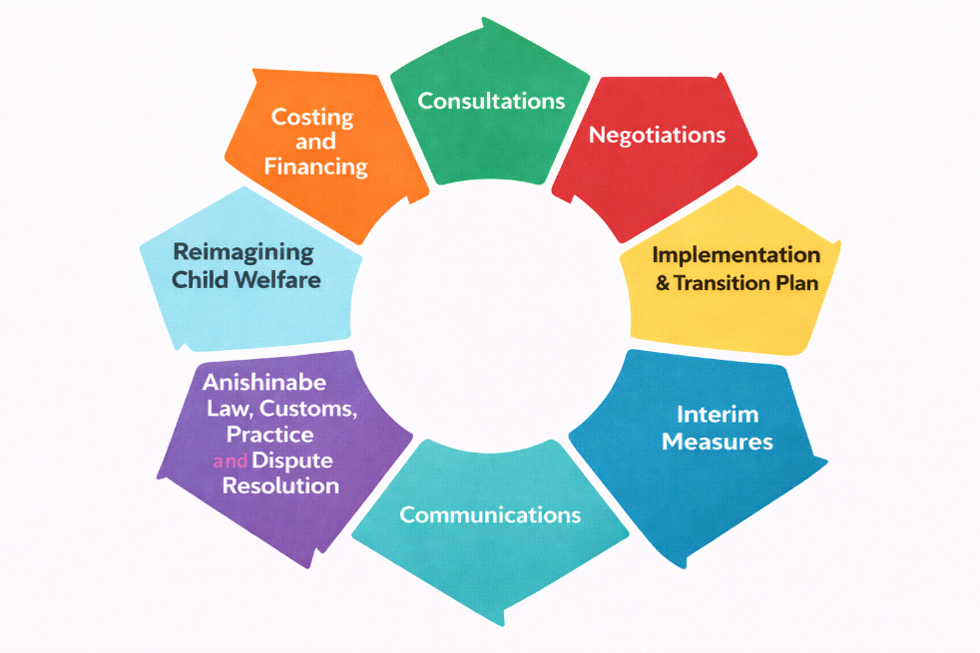
Anishinaabe Customs and Practices on raising children provided a pathway forward that, regardless of component or project deliverable, was always reflective of Anishinaabe ways of raising children. As of March 31,2025, a final generic Koognaasewin Child Wellbeing Law was completed and shared with North Shore First Nations to adapt for their own law development processes.
As Sagamok continues to work towards realizing their vision for Koognaasewin, future blog posts will explore Sagamok’s Koognaasewin planning process and ongoing work towards a reimagined community-based child wellbeing system.


